The story
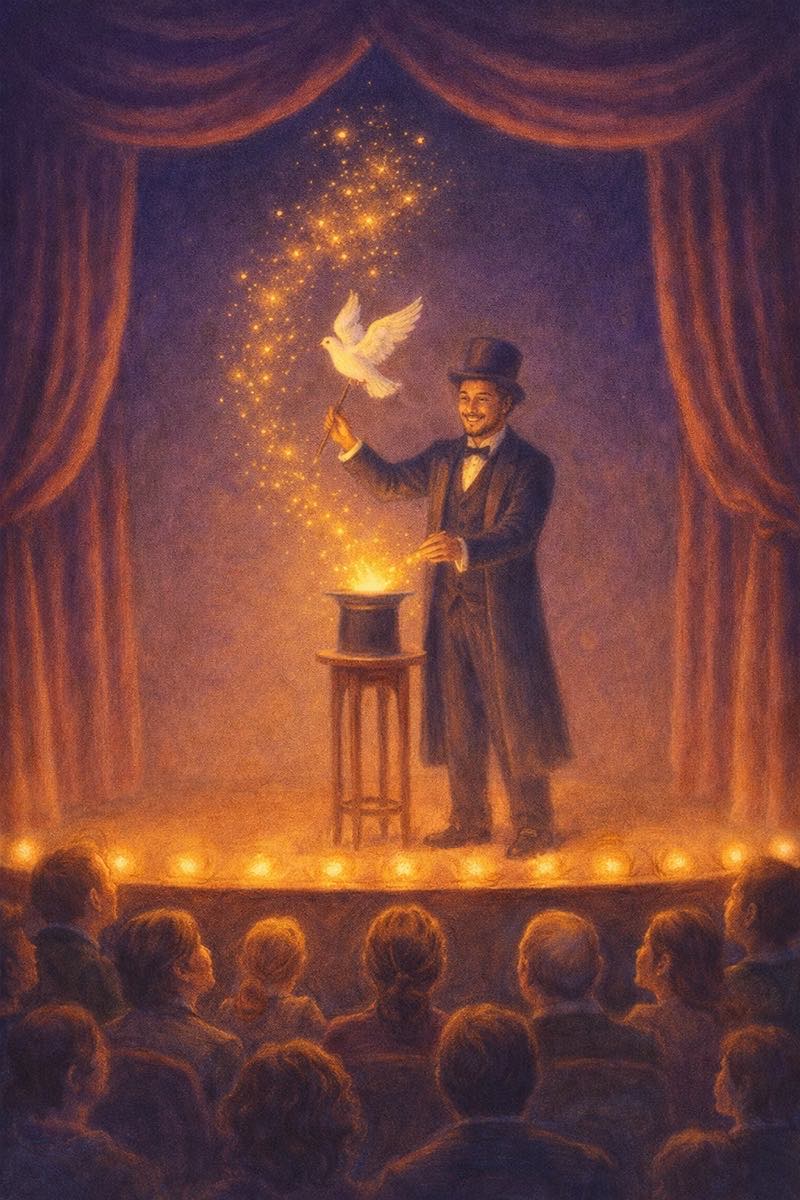
The idea that words have power is very old. A magic word is one said to make something happen, and stage magicians keep a whole collection of them: abracadabra, hocus-pocus, alakazam, presto chango.
Abracadabra is the oldest. Its first known appearance is in a Roman medical book from the second century AD by Serenus Sammonicus. He advised writing the word in the shape of a triangle on a charm, worn by someone with a fever. People believed the shape worked like a funnel, drawing the trouble away. Where the word came from, no one knows for sure. Word sleuths have offered many guesses and proved none.
Hocus-pocus had a showman behind it. A 1635 English book on sleight of hand was titled Hocus Pocus Junior. In 1656, the writer Thomas Ady described a performer who called himself “The Kings Majesties most excellent Hocus Pocus,” and who chanted a string of strange words to dazzle the crowd.
In the age of radio and television, the magic word became a game. On Groucho Marx’s quiz show You Bet Your Life, which began on radio in 1947, the audience learned a common “secret word” at the start. If a contestant happened to say it, a toy duck with glasses and a mustache dropped from the ceiling with a $100 prize.
Comic books joined in too. In 1940, young Billy Batson said one word, Shazam, and became a superhero. So when a parent asks “What’s the magic word?”, a long, playful line of conjurers, comedians and heroes stands behind the question.