The story
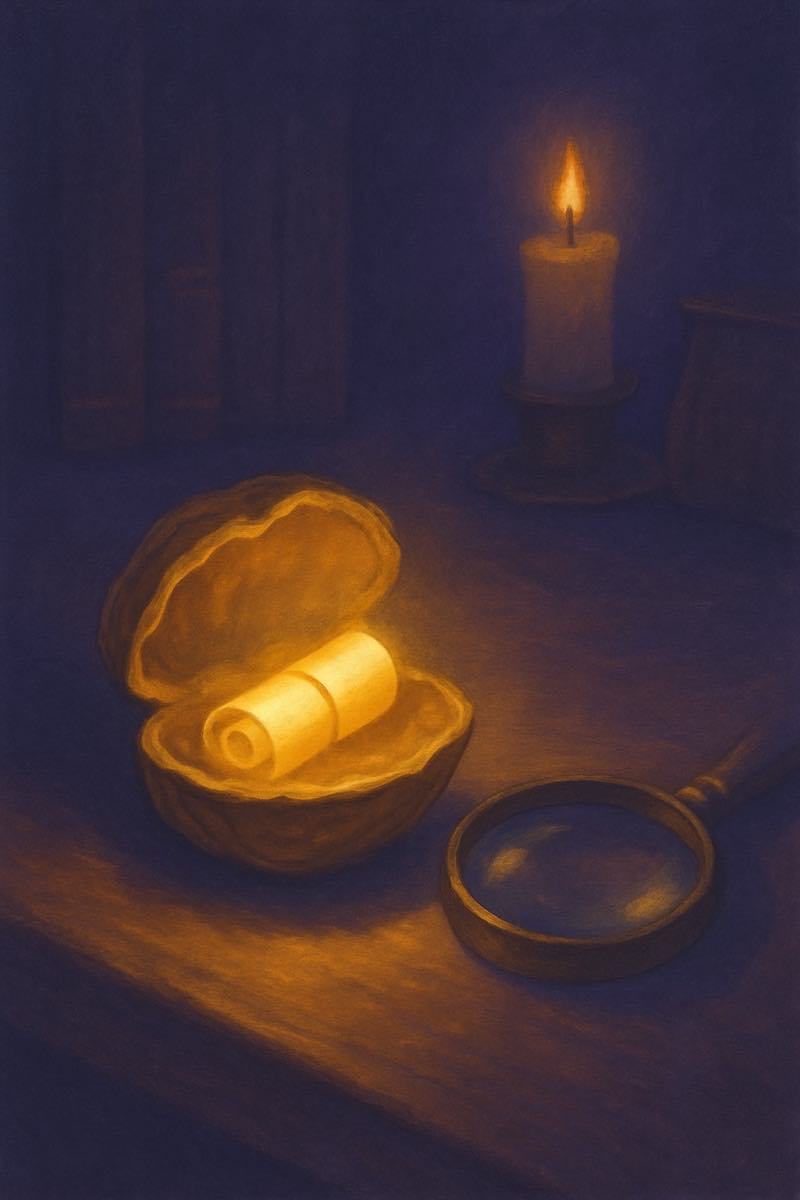
Pliny the Elder, the Roman naturalist, gathered wonders in his Natural History, published around the year 77. One came from the great orator Cicero: a copy of Homer’s Iliad “written on a piece of parchment so small as to be enclosed in a nut-shell.”
Whether that tiny Iliad ever existed, no one can say. But the picture lasted for centuries. Medieval and Renaissance writers kept repeating it as the perfect image of a great deal packed into a very small space.
Shakespeare used the nutshell for smallness, too. Hamlet says he “could be bounded in a nutshell, and count my selfe a King of infinite space; were it not that I haue bad dreames.” A whole kingdom of thought, in other words, inside the tiniest of rooms.
The modern sense, saying something briefly, was in print by 1803. That year a London paper, The Morning Post, wrote of a play’s story: “The historical part of the plot every one knows. It lays in a nutshell.”