The story
Today we say two unlike things are “apples and oranges.” But for hundreds of years, English speakers reached for a far stranger pair: an apple and an oyster. One grows on a tree, the other sits in a shell on the sea floor. Nobody would mix them up.
The apple-and-oyster comparison was already in print in the 1530s, in the age of Henry VIII. In 1670, John Ray, an English naturalist, gathered it into his collection of English proverbs, where things could be as much alike as “an apple to an oyster”—that is, not at all.
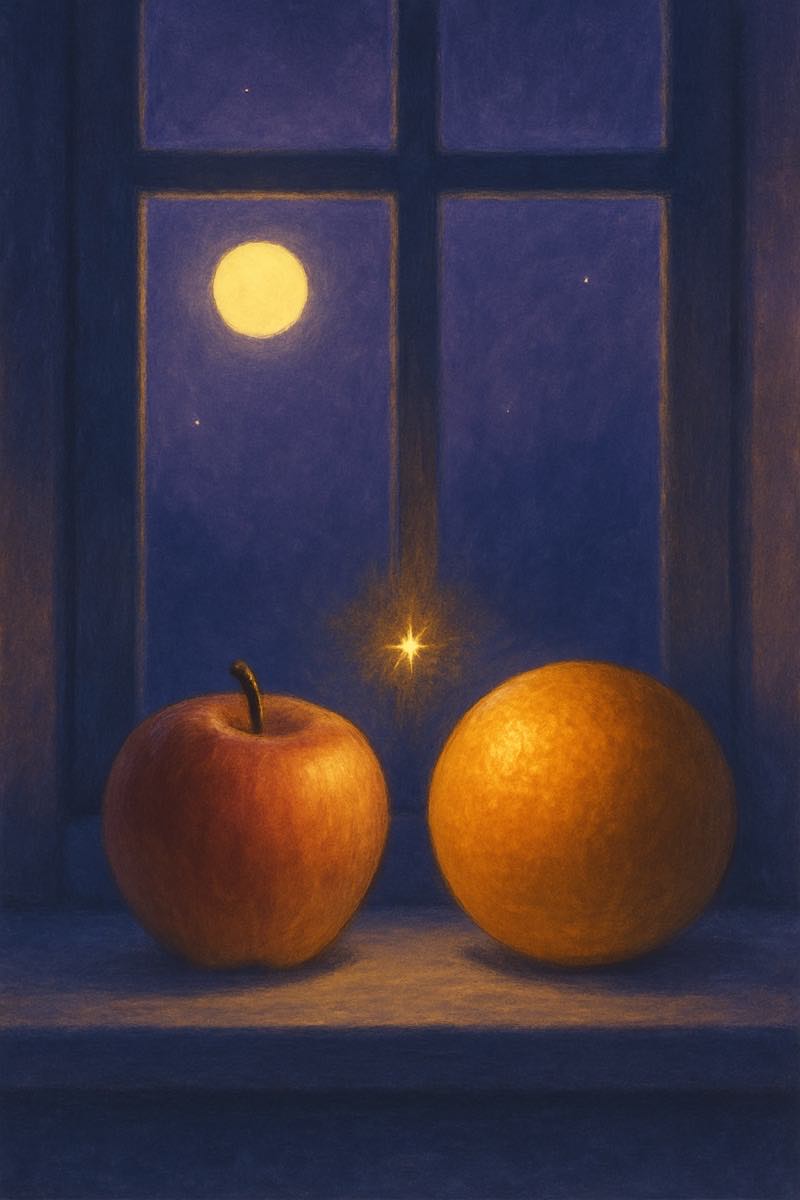
Somewhere along the way, the oyster dropped out and the orange rolled in. No one knows exactly when or why. Oranges became an everyday fruit for ordinary English speakers in the 1800s, and the “apples and oranges” version shows up in print by the middle of the 1900s.
The swap made the saying tidier, and a little funnier. Apples and oranges are both round, sweet fruit that sit side by side in the same bowl. That is exactly the joke: things can look alike and still not compare.