

The story
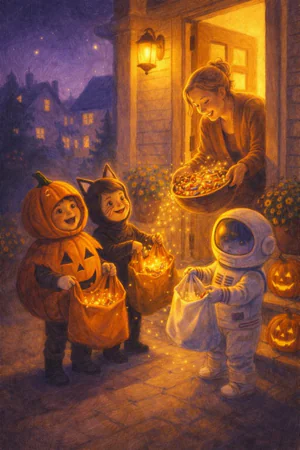
In Scotland, children dressed up on Halloween long before anyone said “trick or treat.” They called it guising, from disguise. A child in costume would come to the door and perform a song, a poem or a joke, and be paid in food or coins.
Families brought the custom to North America. Children were recorded guising in British Columbia in 1898, and a Kingston, Ontario, paper reported children “guising” around the neighborhood in 1911.
Then came the words. In 1917, a newspaper in Sault Ste. Marie, Ontario, reported children calling out “tricks or treats.” A day later, in Chatsworth, Ontario, the familiar “trick or treat” appeared in print for the first time we know of. The idea was playful: give a treat, or risk a harmless prank.
The call spread into the northern and western United States in the 1930s. Wartime sugar rationing slowed it from 1942 to 1947, but by 1952, when Walt Disney made a cartoon called Trick or Treat, it was part of every American October.