

The story
In As You Like It, believed to have been written in 1599, a duke who has lost his throne lives in exile with his friends in the Forest of Arden. One of them, a nobleman named Jaques, begins one of Shakespeare’s most famous speeches: “All the world’s a stage, / And all the men and women merely players.”
He goes on to walk through the seven ages of a life: the baby in its nurse’s arms, the schoolboy dragging his feet on the way to school, the lover, the soldier, the judge, and at last old age and a second childhood.
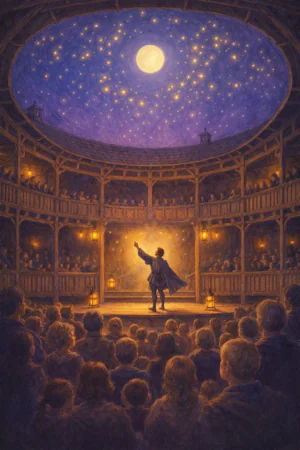
1599 was a big year for Shakespeare’s company. On the night of December 28, 1598, after a quarrel with their landlord, the Burbage brothers and a carpenter’s crew took their old playhouse, The Theatre, apart. In the spring the timbers were ferried across the Thames and rebuilt as the Globe, which opened that summer.
A Latin motto, Totus mundus agit histrionem, “all the world plays the actor,” is often said to have hung at the Globe, but historians now treat that story as doubtful. The idea itself was old. A play by Richard Edwards, written in 1564, the year Shakespeare was born, says “this world was like a stage / Whereon many play their parts.”
Shakespeare had used the picture before, too. In The Merchant of Venice, Antonio calls the world “A stage where every man must play a part.” But it is Jaques’s line, short and easy to remember, that the world still quotes.